Showing posts with label Daniel Evaluation. Show all posts

Wednesday, March 27, 2013

Note to moderator

Dear Moderator,

Hello and welcome to our group blog, thank you for taking the time to look around and we hope you enjoy are blog! The best way to navigate around our blog is by clicking on the labels on the right hand side of the page.

Under the research and planning label, you will find evidence of all the research, planning and development work we did as a group during pre-production, production and post-production stages of our project.

In order for you to see exactly what each candidate contributed to this process, we have also included Individual Contribution labels named for each group member. All research, planning and development posts contributed to by the named candidate will appear when you click that label.

Each member of the group has completed their own evaluation. You can access our responses to the evaluation questions under the individually named Evaluation labels, please make sure to click older posts at the end of the blog page to see the rest of our posts.

Our finished Film Opening Sequence is at the top of the blog, and each candidate has posted their Preliminary Task Video Sequence as part of their answer to Q7 Evaluation.

You can also filter our posts by labels or date, and there is a blog archive if you want to look through chronologically.

You will also find a link to the Class Film Blog which contains links to the other group blogs from our school.


Once again thank you for taking your time to read our blog and we hope you enjoy reading and watching the content on our blog!

From,
Aidan Szczurek, Candidate number- 1770
Jeremy Kumarathasan, Candidate number- 1400
Daniel Gittings, Candidate number- 1230

Wednesday, March 20, 2013

Evaluation 1

In what ways does your media product use, develop or challenge forms and conventions of real media products?

We needed to research the conventions of genre, narrative, form and style to know what to conform to, and to ensure our opening was instantly recognisable to films in that genre.

Genre: Zombie-action sub-genre


To use the presentation above, press the button in the middle saying 'Start Prezi'. Then wait for the blue bar at the bottom to load. Finally press the right arrow at the bottom to look through and press fullscreen if you need it to be larger.

Narrative structure


Todorov's Theory

Todorov was a theorist who decided to split up the generic structure of events in a film into a general theory.

He showed that all films have to start off with an equilibrium. This is where the audience gets a sense of what the film events and surroundings are supposed to be like. You would learn about routines and how people are generally living. In apocalyptic zombie films like ours the equilibrium seems really far from reality but the audience still withholds their disbelief and accepts it as the normal while they view it. In our opening we set up the equilibrium as a dystopian suburban location where zombies roam around. There are a few survivors who are well equipped and are trying to kill the zombies. It also shows how Daniel and Maran are familiar with zombies and aren't surprised when they get chased. In these shots we used cross cutting between the zombies and the protagonists to show how they were close and connected,  and a real and present danger.

Then there is normally a disruption. This is where an event disrupts the equilibrium often  in a surprising way.It happens early in the film and is used as a device to  hook the audience in. In our film you see the disruption at the end of our opening. This is where Daniel sacrifices himself to save Maran and then Maran gets knocked out by a rival gang member who you would later find out to be the main antagonist. This also creates narrative enigma as the audience don't know who knocked him out and what is Marans' fate. This  in itself creates a cliffhanger.

Once the protagonists recognise there is a change they will try to fix it which is their attempts to repair. This is how they have to overcome obstacles to try to fix what the disruption caused. This will consist of the main part of the film as it is the most interesting and has the most plot twists, as they will normally have minor disruptions within the attempts to repair to keep the audience intrigued. We would have this as a hostage note or a cry for help from Maran, back to his group. Then his group would attempt to rescue him.

Todorov finally said that it always has to finish with a new equilibrium (or a return to the original). This is once the protagonists have completed their task or failed at it. It is where the audience is supposed to accept that that is the end and things will supposedly stay that way. We would finish our film with Maran being saved from the rival gang, though some of his group may be lost in the process to create a new equilibrium.

Form

The role of an opening sequence is to introduce key characters, use title to provide institutional details, establish narrative and establish and anchor the genre.

We did our research on titles for the Zombie/Action genre and discovered they  often choose dark colours. We used a dark red to represent our bloody theme. We used Live Type to execute the best possible text.


The music we used works in synergy with the action  happening on screen This made sure we raised the tension and the excitement. In our research we found out that in  films  like Resident Evil this is very effective. It took us a while to find the music, but it was the best one we found.


Style

To create the correct dystopian effect to go with our genre we had to get the right grading, which was slightly dim and gloomy to represent the atmosphere of the situation and the film. We graded our opening in comparison to 'I am Legend' and '28 days later'. We wanted our film to be realistic and represent the gritty reality of an apocalypse creating an atmosphere of hopelessness that underlies everything.

My video commentary below is me talking about how different aspects affect the audience and what we were trying to achieve.

Due to technical difficulties the video below has strange flashes and is jolty in places.


Evaluation 2

How does your media product represent particular social groups?

In our current society we felt that the norm is that we are very multicultural. This is why we broke the zombie-action stereotypes of using only white-British actors as this view is outdated and it would be unrealistic to not have a diverse ethnic cast. We tried to represent a wide range of social and ethnic groups in our film and we did this by having these groups represented positively in certain characters.

Both of our protagonists are young males which is our core-target audience. We later introduce a female, around the same age who becomes one of the leaders but at the same time is a 'princess' due to her being the love interest.

Daniel

Daniel is a white male who is around 18 years old. He is a weapons expert as shown by him handling and using the advanced sniper rifle. He is one of the leaders of the main group with strong leadership qualities and  a likable character. He is depicted as experienced and selfless as he chooses to sacrifice himself to save his comrade. He is inspired from Bob Lee Swagger in 'Shooter'. This is because of his cool headed approach at leadership and his precision with any kind of rifle. He is portrayed as an inspirational figure and is a great action hero. This challenges the conception of teenagers as they are portrayed as rowdy, obnoxious and selfish. This has been shown in lots of news coverage like the London riots and multiple stabbings around London.


Maran


Maran is a South Asian male who is also aged around 18 years old. He is the scout who is also experienced as he gives very precise details on wind direction and distances ensuring Daniel gets the right shots. He is shown to be an equal as Daniel asks Maran for advice about whether they can 'take' the zombies. This challenges the racial stereotypes that the foreign character is a failure and dies first. We felt that this keeps it current to the ethnicities in England and also helps us to not put off some of our target market. We feel strongly that new films shouldn't conform to these outdated views.


We later introduce a female into the group who is strong willed and is a very good fighter. We took inspiration from Michone who is a brilliant female fighter in the hit TV series The Walking Dead. This also challenges the stereotype that only males are strong physically and can fight

Evaluation 3

What kind of media institution might distribute your media product and why?

As our film was a British production we wanted to use British production and distribution companies. We researched different distributors and producers and decided that Momentum Pictures and Bitten Productions would be the best studios to distribute our film as they fit well with our films genre and principles.

Momentum Pictures


We chose momentum pictures as our distribution company as they are a well known and highly popular British distributor. Our film is a solely British production and would be highly suitable for Momentum Pictures as they have previous success in the Zombie genre with films like The
Crazies, a film similar in many respects to our own. It didn't need a huge budget ($20 million), as it relied on high quality cinematography rather than expensive effects. It isn't a huge blockbuster but it is focused on creating a good film rather than just focusing on profits. It didn't have a saturated release since it doesn't have that wide reach.As Momentum Pictures have plenty of resources, they could easily get our film into the cinemas we want it to be in, as they have done the same before with films like The Crazies, Hobo with a shotgun, Seven Psychopaths and Haywire.


Bitten Productions


We decided to create our own production company, Bitten Productions. We needed an organisation that specialised in post-apocalyptic films.It would be well established with a good track record of producing high quality films in the Zombie genre. Its successful reputation would attract a faithful audience to films associated with its brand. 


Evaluation 4

Who would be the audience for your media product?


Primary audience


Our primary target audience would be predominantly males aged between 15-24. This is one of the largest groups that go to watch films in the cinema giving us a large reach. The two protagonists are in this group who our audience can identify with and aspire to. They are a mix of social and ethnic backgrounds to keep with current reality of the racially diverse England. We also chose this age group as we can identify with it as we are young directors. We wanted to have some blood and gore like dead zombies eating bodies thereby needing a 15 certificate rating eliminating younger viewers which is why we focused on the older ages.

Secondary audience

Our secondary audience would be females aged 15-24 and fans of the zombie-action genre. We chose this as we follow many conventions from previous zombie-action films like Zombieland, 28 days later, Resident Evil and Dawn of the Dead. This indicates that people who are attracted to these films would likely be drawn to our film. The female protagonist who later enters the film would also feature prominently in our marketing material.She is young, strong but still distinctly feminine. A figure women of this target group would aspire to.

Evaluation 5

How did you attract/address your audience?

We used our knowledge of uses and gratifications to manipulate our audience into a good experience of the film and also chose specific characters to address different groups and attract them to watch our film.


Our film includes plenty of action sequencies along with cliff hangers and a narrative enigma as shown in our film opening . The audience are kept in suspense keen to follow the unpredictable storyline.Our audience will be familiar with the concepts we use and any developments we have made are still convincing and believable.With aspects of the horror genre we take the audience through an emotional roller coaster.They are sad and disturbed over the early loss of Daniel in the opening sequence and then shocked by the rifle butt knock-out of Maran.We will then use zombies through out the film as a few jump scares to keep the audience engaged with the film. Audiences enjoy feeling emotion when they go to the cinema even if it is sadness or fright. We will use this to enthrall our audience to keep them wanting more.


 The action genre is enjoyed largely by males in the 15-24 year age group. Conventionally they enjoy shooting, explosions and people killing each other. We have kept to the action genre by including plenty of action with gunshots, fight scenes, blood splatters and explosions. This is what our key target market wants to see in a film. We also made sure we had protagonists in this group to have people that they can relate to. This is important as they will be on the posters and in the adverts to draw our key audience to come to our film. Due to the recently extremely popular video game Black Ops: 2, which has a whole mode based around zombie survival, our target market will make instant connections between them as our primary audience is the same as the games' and our title has strong references within the game. As this game is one of the top 10 best selling video-game franchises of all time, this gives us a greatly extended reach to our audience as they will feel a lot more involved and that they have a much bigger connection to our film.


One of our male protagonists is a British-Asian who has a very strong positive representation. This would attract the British-Asian market to watch our film and as this is a very large audience in Britain it would increase our reach a great deal.


Our female protagonist is young and strong but distinctly feminine and will also feature in our marketing which will attract both our primary and secondary audience.

Evaluation 6

What have you learnt about technologies from the process of constructing this product?

Our research that we conducted during this process and the learning from setbacks led us to have a much better understanding of film making and the technologies used in it.

Film making has had a massive impact from technologies throughout it's cycle as they are always connected together. Different genres rely more on it than others, like action, but you still need a story-line to make a good film. We found that however good or bad our equipment was, it was down to us to make a good film and the technology would only be able to make it look prettier. The most we learnt was about how to use the technologies to make the most out of our resources.

Below is our directors commentary where we discuss thing that we learnt, things that we would change in hindsight and general obstacles that we had to overcome.


Software:

We used Adobe Premier Pro to edit our sequence together. We have used this previously in GCSE work and our prelim work. We cut our clips from the raw footage using the razor tool and the crop tool. We had to use the speed/duration for certain clips to get the right effect that we wanted to use like slow-motion or to speed a scene up.

We had to spend a long time with brightness, contrast and saturation due to our shot being shot over the duration of the day so our lighting changed quite dramatically. This meant we had to change every shots grading to get the look of an apocalyptic zombie film and to make them all look as if they are at the same time of day as only 2 minutes 30 seconds have passed.

Before we started our actual production we planned our shots out by using an animatic. This gave us an idea of timing and to see what was missing.


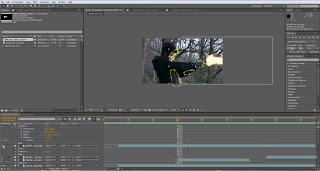
As our film was in the action genre we needed to have a lot of special effects. For these we used Adobe After Effects which had all the tools we needed. We needed to add muzzle flashes, explosions and blood splatters to keep with the conventions of the genre. For this we researched how to accurately do this on YouTube. We found that to achieve the most accurate muzzle flashes we needed to have moving clips from an effects cache and then use a mask over the character and gun to make sure it seemed as if the flare was in the correct place in the frame. We also found out to our surprise that we needed to make the flare react with the environment. For this we had to create a second mask and then add brightness to the areas of the environment that would be affected. It is a near identical process for explosions and blood splatters and the only difference is that you do need to have it lasting for many more frames, which means you have to move the mask for each frame rather than having one for one frame which makes the blood splatters and explosions much more time consuming.

Evaluation 7

Looking back at your preliminary task, what do you feel you have learnt in progression from it to the full product?

Our prelim task prepared us for shooting a continuous running narrative that had to make sense and contain events and action.

Below is our prelim video which we made to practice creating a continuity sequence. Ours was called 'The G' and we needed to include techniques like match-on-action and reverse shots.


Planning

In our prelim we learned how we were supposed to properly and successfully plan a short clip. We learned how to draw out a clear and useful storyboard which would actually help us throughout the production stage. We also realised we had to have a script to fall back on as we learned the hard way that if we had to re-shoot we said different things at the different shoots. Then once we had both of these we needed to create a shot-list for the actual shoot. This contained the type of shots we use, the dialogue in the shot, the length of the shot and all the shots order. We realised that we wouldn't have been able to cope without this and was the most important thing on the shoot day.

Technologies

As I have said in the previous question we used lots of different technologies in our production. We first used all of the basic techniques like cutting, dragging, fades and stitches in our prelim. These techniques made a base for the more complex ones that we used in our final media product.

Techniques:

Match-on-action:
We learned how to use this in our prelim by matching shots of opening doors and people sitting down. This gave us a sense of continuous motion and making everything seem fluid. In our actual media product we had to use match-on-action for the walking through the forest. This meant we had to take all the shots all the way through from each angle so we could edit them together at the correct places.

180 degree rule:
We struggled with this in the prelim task but we learnt from our problems and ended up using the rule to our advantage to get shots from the angle we wanted. At 0:36 in our opening sequence we needed to have our next shot from a certain side. This meant we had to have the camera cross the 180 degree line mid way through the shot. We could then have the camera on the right side of Maran when he looks in his binoculars.


Cross-cutting:
For our prelim we needed this to cut between the two characters, to show that two things are happening at the same time. For our media product we had to cross-cut between the zombies and the protagonists. This meant that we were able to shoot each shot seperatley and then just time them correctly in the edit. This gave us more freedom which made things easier.